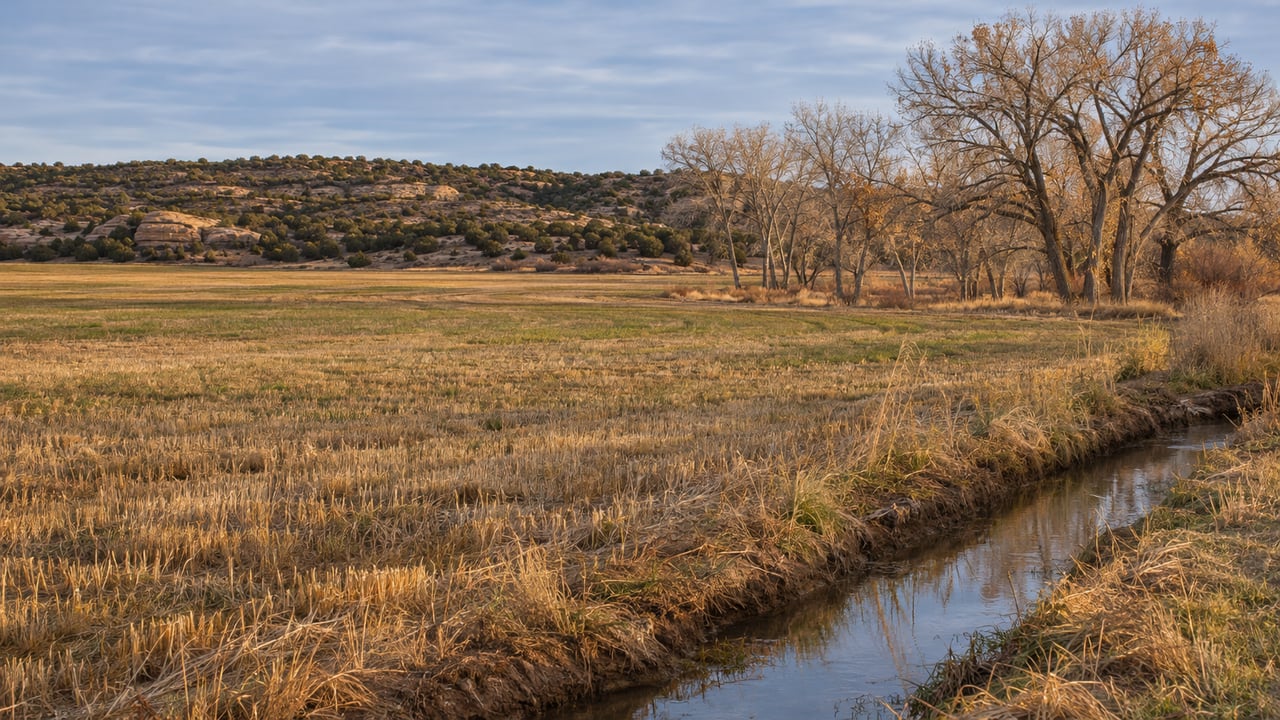
Every morning at 9, longtime National Weather Service spotter Jim Andrus checks the rain gauge at his Cortez property. The Journal reported that he recorded 4.88 inches in October 2026. A normal October brings about an inch. Before that rain, the 2026 irrigation season around Cortez had been one of the hardest in the Dolores Project's history.
If you're comparing irrigated acreage in Montezuma County this winter, both halves of 2026 bear on the land you're looking at. The dry season showed which fields still got water when supply ran short. The wet fall changed the reservoir that 2027 depends on. A listing that shows a share count describes a normal year. This year showed what a share delivered in a bad one, and the answer depended on which water system served the field.
A Season That Ran at 14 Percent
Dolores Water Conservancy District General Manager Ken Curtis called the 2026 water supply "abysmal" in an August interview with KSJD. He said full-service irrigators on the Dolores Project received about 14 percent of a full supply this season, while the Montezuma Valley Irrigation Company was running at roughly 55 percent. He ranked 2026 among the third- or fourth-worst runoff years on record for the project. He said "unprecedented" heat in March melted the snowpack early and cut the runoff that normally refills McPhee Reservoir.
The shortfall was visible early. In April, The Journal reported the district's first estimate for full-service irrigators: about 3 inches out of a normal 22, still subject to runoff forecasts. By mid-August, McPhee was close to running out of active storage. Curtis said it was about six feet above its lowest allowed operating level on August 13 and expected to reach that level near the end of the month. He also said municipal water supplies were protected and would keep running all year, and that agricultural users took most of the shortage.
For a buyer, the gap between 14 percent and roughly 55 percent is the main finding of 2026. Two irrigated parcels can look alike on paper, with similar acreage and water listed in the disclosures. In 2026, one of them could still grow a crop and the other could not.
The Same County, Two Different Summers
Curtis described what that gap looked like on the ground. Fields in the Montezuma Valley served by senior water rights stayed greener this summer, while many fields farther north toward Pleasant View were left fallow, KSJD reported.
The Montezuma Valley water also fell short of normal. MVIC's posted 2026 allocation is 2.3 acre-feet per share, which the company equates to 27.6 inches over 92 days. In March, MVIC set its starting allocation at 18 inches per share. The conservancy district's March 12, 2026 board minutes note that MVIC's allocation has historically ended between 3 and 4 acre-feet per share. That puts this year's posted figure about 23 percent below the low end of that range and about 42 percent below the high end.
So a share of MVIC water near Cortez delivered noticeably less than usual in 2026, and it still held up far better than project water to the north. The share count tells you how much of a supply a parcel holds. In a year like 2026, the source of that supply decided how much water actually reached the field.
The minutes also give one of the few public prices for this water. In 2025 the district leased its MVIC Class A water at $34 per acre-foot, and the 2026 base rates had not increased as of March. That is a lease rate between the district and another user. It is not the price of a share or of irrigated land.
What the Short Year Cost on the Farm
The effects showed up in what growers planted and harvested. In June, KSJD reported that growers were planting fewer fields and putting their limited water on priority crops. Some alfalfa producers expected one cutting instead of the usual three, and livestock operators were looking at buying hay or bringing it in from farther away. An August KSJD harvest report said limited irrigation and heat were cutting yields and raising production costs, and some growers might raise prices on locally grown food to stay in business.
That gives a buyer a practical question to ask about any irrigated parcel. Ask what the field produced in 2026, not only what water it holds. The number of hay cuttings, the acres that went unplanted, or whether the owner bought hay this year will tell you more than the water line in the disclosures about how the land handles a short year.
October Changed the Reservoir
Then the fall turned wet. Curtis told The Journal in late October that precipitation had run five to six times higher than expected and runoff nearly 10 times the October average. McPhee gained 8,000 acre-feet in September and another 34,000 in October, for a rise of about 12 feet. "We are still very low. We were almost at dead or an inactive pool, so 12 feet is great, but we have a long way to go," Curtis said. At that point the reservoir was still 51 feet from full.
November added more. Provisional Bureau of Reclamation data show these readings for McPhee:
| Date, 2026 | Elevation (feet) | Storage (acre-feet) |
|---|---|---|
| October 31 | 6,876.53 | 205,907 |
| November 2 | 6,885.40 | 232,926 |
| November 15 | 6,893.86 | 261,412 |
That is about 55,500 acre-feet and more than 17 feet in the first half of November, and about half of that storage came during a large inflow spike on November 1 and 2. Snowpack started strong too. The Natural Resources Conservation Service's provisional report for November 15 put the combined San Miguel, Dolores, Animas and San Juan basin snowpack at 170 percent of median.
This is a good start to the season, and it is still only a start. Curtis made the same point in August, saying the project is "totally at the mercy of winter snowpack" and that one good winter could restore a full supply, while anything less than a more typical winter could bring another shortage year. The late-fall water has moved McPhee off the bottom, but the irrigation supply for 2027 still depends on how much snow falls between now and spring.
Buying Into That Gap This Winter
That timing matters to anyone shopping this winter. Sellers of irrigated land are coming off the 2026 season, and a buyer looking now is choosing before anyone knows what 2027 will deliver. The county's housing market gives buyers time to think it through.
Across Montezuma County, single-family homes that sold in October 2026 spent an average of 134 days on market, up from 119 in October 2025, according to the Colorado Association of REALTORS county report. Inventory reached 175 homes, months of supply rose to 8.3, and sellers received 95.2 percent of list price. The year-to-date median through October was $426,000, up 2.7 percent from the same stretch of 2025, on 220 sales compared with 221. October's single-month median of $520,000 came from only 23 sales, and the report itself cautions that small monthly samples move around. These are countywide figures for all single-family homes. They are not a separate count of irrigated parcels.
Negotiations in the county had already shifted by spring. In an April KSJD report, local realtor Leigh Holmes said "buyers are able to throw their weight around a little more," including on repairs. With 8.3 months of supply in October, a buyer has room to ask for a parcel's 2026 delivery history, what it produced this year and how the seller managed the short season, and to factor those answers into an offer.
House water is a separate cost from irrigation water, and on rural parcels it is part of the price. Montezuma Water Company's July 2026 schedule lists $12,500 for a residential Type I membership, $2,500 for tap installation and a $41 monthly base charge for a 5/8-inch meter, revised January 1, 2026. Inside Cortez, the city's 2026 water schedule lists an $8,120 tap and development charge for a 3/4-inch connection and a $33.40 residential base rate. The same schedule lists development charges 50 percent higher outside city limits. On a rural parcel, a water tap already in place is worth asking about. These figures are general information, not legal, tax or financial advice, so please confirm the costs and terms for any specific parcel with the water provider and the right professional before you rely on them.
Frequently Asked Questions
Did the October rain help this year's crops? No. It came after the 2026 growing season. What it did was lift McPhee Reservoir from near its lowest operating level to 6,893.86 feet as of November 15, according to Bureau of Reclamation provisional data.
Is the 2.3 acre-feet per share MVIC's final number for 2026? It is the allocation MVIC has posted for 2026, and the company says it is subject to monthly review. The company is the place to confirm current figures for any shares tied to a property.
Do the county market figures cover irrigated land specifically? No. The Colorado Association of REALTORS figures cover all single-family homes in Montezuma County, which includes in-town homes in Cortez, Dolores and Mancos as well as rural homes.
If you're weighing irrigated acreage around Cortez this winter, we'd be glad to talk through the parcels on your list and what each one did in 2026. Reach out to The Overington Group through our contact page, or start with our Cortez neighborhood page and our buyers team.